
WHAT IS PHYSICAL THEATRE? – INTRODUCTION
Physical theatre, an art form that fuses movement, gesture and expression, has significantly shaped the landscape of the performing arts throughout the 20th century. In essence, physical theatre transcends conventional boundaries and uses the body as its primary means of expression. Thanks to the innovative contributions of renowned figures such as Etienne Decroux, Vsevolod Meyerhold and Jacques Lecoq, physical theatre has evolved into a dynamic form that challenges both actors and dancers to explore the complexities of movement and expression.
A DEFINITION OF PHYSICAL THEATRE
Physical theatre is characterised by its emphasis on the physicality of performance, moving away from the spoken dialogue typical of traditional theatre. Instead, physical theatre communicates narratives, emotions and ideas primarily through movement, gesture and expression. This immersive mode of narration engages audiences across linguistic barriers and invites them to immerse themselves in a world in which the body becomes the primary vehicle for conveying the inner realm of emotions, conflicts and desires.

PIONEERING PHYSICAL THEATRE FIGURES
To understand what physical theatre is, it is important to look back at its history and evolution. The evolution of physical theatre owes much to the pioneering work of Etienne Decroux, Vsevolod Meyerhold and Jacques Lecoq.
Etienne Decroux, French actor and researcher, is considered the father of modern mime. His work in corporeal mime focused on unlocking the expressive potential of the body through a precise study of articulation and chronology, allowing time and processes to become visible in the performer’s body.
Vsevolod Meyerhold, Russian theatre director and theorist, developed biomechanics, a systematic approach to actor training based on movement and gesture. His emphasis on precision and physicality laid the foundations for physical theatre as a distinct form.
Jacques Lecoq, French actor and pedagogue, developed a holistic approach to actor training, integrating movement, masks and improvisation, and encouraging performers to fully embody character through physical expression.
CORPOREAL MIME: A BRIDGE BETWEEN THEATRE AND DANCE
Corporeal mime represents a vital bridge between text-based theatre and dance, offering performers a rich expressive language through gesture, emotion and narrative.
Unlike traditional mime, corporeal mime can integrate spoken dialogue, sound and voice, expanding the range of expressive possibilities.
Its affinities with modern dance emphasise precision, control and emotional authenticity, enriching physical expression.
THE NEED FOR PRECISION AND CONNECTION
In physical theatre, precision and connection are central concepts. Every gesture matters and requires rigorous training in movement, acting and improvisation.
Physical theatre opens new ways of understanding the body in action on stage.
MOVEO´S PHYSICAL THEATRE TRAINING
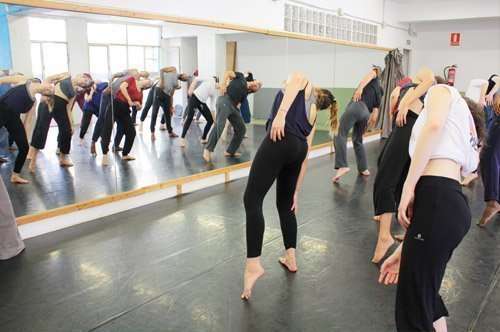
Moveo’s training in physical theatre and corporeal mime is structured around two main areas. The first focuses on in-depth corporeal mime training, covering technique, improvisation, repertory, composition and creation practices, and represents 85% of the syllabus.
The second area integrates contemporary dance, physical training and voice work, representing 15% of the syllabus and enhancing expressive possibilities.
Training takes place daily from October to June with an international group of students and aims to transmit the knowledge and experience of the teaching team while building a strong technical and artistic foundation.